Trigun
Start here for the classic path. These 26 episodes introduce Vash the Stampede and build the world at a relaxed pace, opening with episodic comedy before the story turns serious in its second half.
A gunslinger with a 60 billion double-dollar bounty on his head wanders a desert planet, trying to avoid killing anyone despite a reputation for leaving cities in ruins.
4 titles · 50 episodes + 1 movie · ~21.5 hours
Trigun exists as two separate takes on the same manga, and neither one continues the other. The 1998 TV series plus the 2010 film form one complete path. TRIGUN STAMPEDE and its 2026 conclusion TRIGUN STARGAZE form the other. Both start from scratch, so pick one path and follow it through. If you want to watch everything, finish one path before starting the other rather than alternating between them.
Start here for the classic path. These 26 episodes introduce Vash the Stampede and build the world at a relaxed pace, opening with episodic comedy before the story turns serious in its second half.
A standalone film made by the same studio and director as the 1998 series, with the same cast. Watch it after the TV series, since it assumes you already know the characters.
The other starting point. This is a full retelling rather than a sequel, so it needs no knowledge of the 1998 series. Twelve episodes, tighter and faster than the original.
⚠ The full CG animation is a significant departure from the 1998 series and is the main reason viewers bounce off this version. Worth sampling an episode before committing.
Picks up two and a half years after STAMPEDE and finishes the story. Twelve episodes, aired January to March 2026. Watch it straight after STAMPEDE.
The two versions are roughly the same size, so this is a genuine choice rather than a main version and a bonus. The 1998 series runs 26 episodes and takes its time, opening as a comedy and turning steadily darker; the 2010 film Badlands Rumble is a standalone story made by the same studio and staff, so it belongs at the end of that path. TRIGUN STAMPEDE restarts the story in full CG with a tighter structure and a different emphasis, and TRIGUN STARGAZE follows on directly to finish it, giving that path 24 episodes across two seasons. We list the 1998 path first because it came first and because its 26 episodes are the version most English-speaking fans grew up with, but starting with STAMPEDE is equally valid — it assumes no knowledge of the older show. The one order to avoid is mixing the two, since the same events are told differently in each and the overlap will read as contradiction rather than continuation.
Across both versions, Trigun has 3 seasons and 1 film — 50 episodes altogether.
| Title | Type | Episodes | Aired |
|---|---|---|---|
| Trigun | TV Series | 26 episodes | April 1998 |
| Trigun: Badlands Rumble | Movie | April 2010 |
| Title | Type | Episodes | Aired |
|---|---|---|---|
| TRIGUN STAMPEDE | TV Series | 12 episodes | January 2023 |
| TRIGUN STARGAZE | TV Series | 12 episodes | January 2026 |
4 titles · 50 episodes + 1 movie · ~21.5 hours
Where each part of the anime lines up with the source, so you know where to pick up reading.
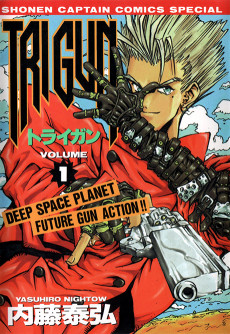
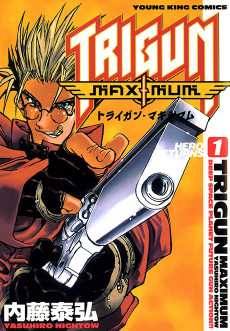
Yasuhiro Nightow's manga was published in two parts. The original Trigun ran from 1995 to 1996 and was collected in three volumes, later reissued as two; the story then moved magazines and continued as Trigun Maximum, which ran until 2007 and finished in fourteen volumes. The 1998 anime covers only the earliest part of that run — its ending is anime-original, written because the magazine serialising the manga shut down while the show was in production. TRIGUN STAMPEDE and TRIGUN STARGAZE do not track the volumes either; they restage the material with their own structure and ending, so there is no volume-by-volume correspondence to give for them. Whichever version you watched, the manga continues well past it. Dark Horse publishes the English editions: Trigun in two volumes and Trigun Maximum in fourteen, with recent hardcover Deluxe Editions collecting Trigun in a single book and Trigun Maximum across five.
Choose one of two paths rather than watching all four titles in a single run. The classic path is the 1998 TV series (26 episodes) followed by the 2010 film Trigun: Badlands Rumble. The reboot path is TRIGUN STAMPEDE (12 episodes) followed by TRIGUN STARGAZE (12 episodes). Each path is complete on its own and neither requires the other.
No. They are separate adaptations of the same manga, not sequels to each other. TRIGUN STAMPEDE is not a continuation of the 1998 series and assumes you have seen nothing before it. Watching both is worthwhile if you like the material, but finish one path before starting the other.
Start with the 1998 series if you want traditional animation and a longer, more episodic build. Start with TRIGUN STAMPEDE if you want a newer, tighter version and do not mind full CG. Both are valid entry points, and the two paths are close in length — 26 episodes plus a film on one side, 24 episodes on the other.
Yes. It is a standalone story with no bearing on the rest of the 1998 series, so nothing later depends on it. It was made by the same studio, director and cast as the TV series, which is why it plays best after you have finished those 26 episodes. The reboot path has no equivalent film.
Yes, for the reboot timeline. STARGAZE was announced as the final phase of TRIGUN STAMPEDE and ran for 12 episodes from 10 January to 28 March 2026, ending the conflict the first season set up. No further seasons have been announced. The 1998 series is a separate timeline and reached its own ending in 1998.
All four titles stream on Crunchyroll, and the 1998 series and Badlands Rumble are also on Hulu. Every title has an English dub — Johnny Yong Bosch voices Vash in all four, having first taken the role for the 1998 series. The dubbed finale of TRIGUN STARGAZE went up on 11 April 2026, so both audio options are complete for every entry.
No. Yasuhiro Nightow's manga ran as Trigun (three volumes) and then as Trigun Maximum (fourteen volumes, finished in 2007). The 1998 series adapts only the early part before the original magazine folded, then goes to an anime-original ending. STAMPEDE and STARGAZE retell the material rather than adapting it volume by volume, and reach a conclusion of their own design. Reading the manga after either version still leaves most of the story ahead of you.